Area Between Two Curves
Definite integrals, intersections, vertical boundaries and upper minus lower.
On this page
1What area are we trying to find?
In this topic, we want the area enclosed between two curves. Visually, this is the region trapped between one graph above and another graph below over an interval from \(x=a\) to \(x=b\).
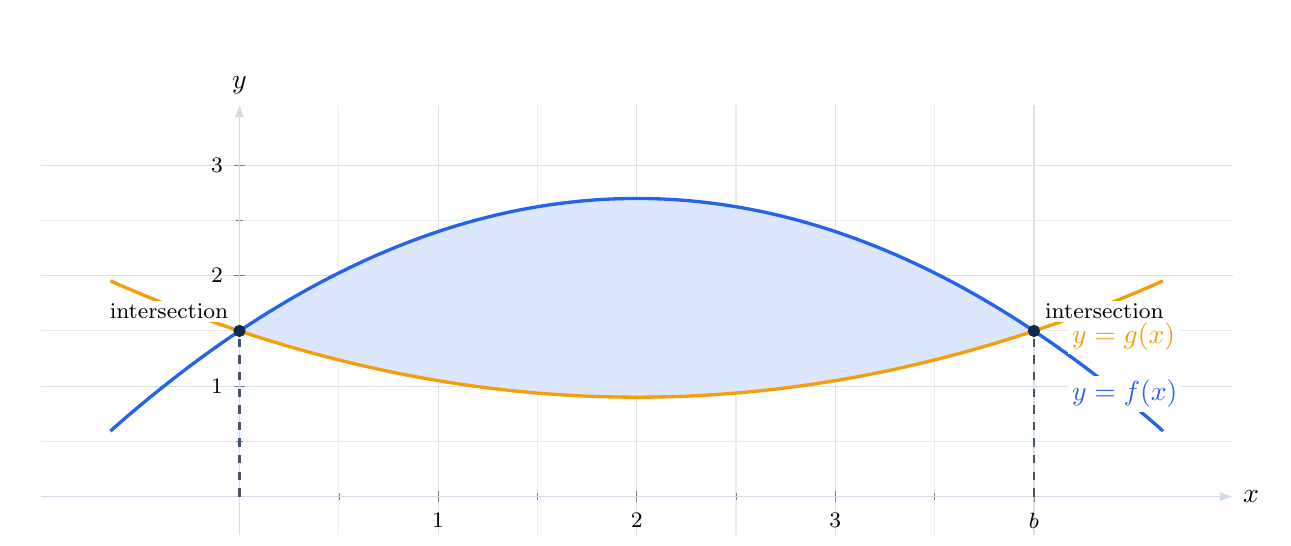
The area is built from vertical slices. On each slice, the height is the upper curve minus the lower curve. This turns the picture into the integral
\[A=\int_a^b(\text{upper}-\text{lower})\,dx.\]Before writing any integral, first decide: which region is being found, where the boundaries come from, and which curve is on top. Once those three ideas are clear, the algebra becomes much easier.
2Step 1: identify the scenario and the limits
The first decision is not the formula. The first decision is the scenario: are we finding the whole enclosed region, or only the area on a specified interval?
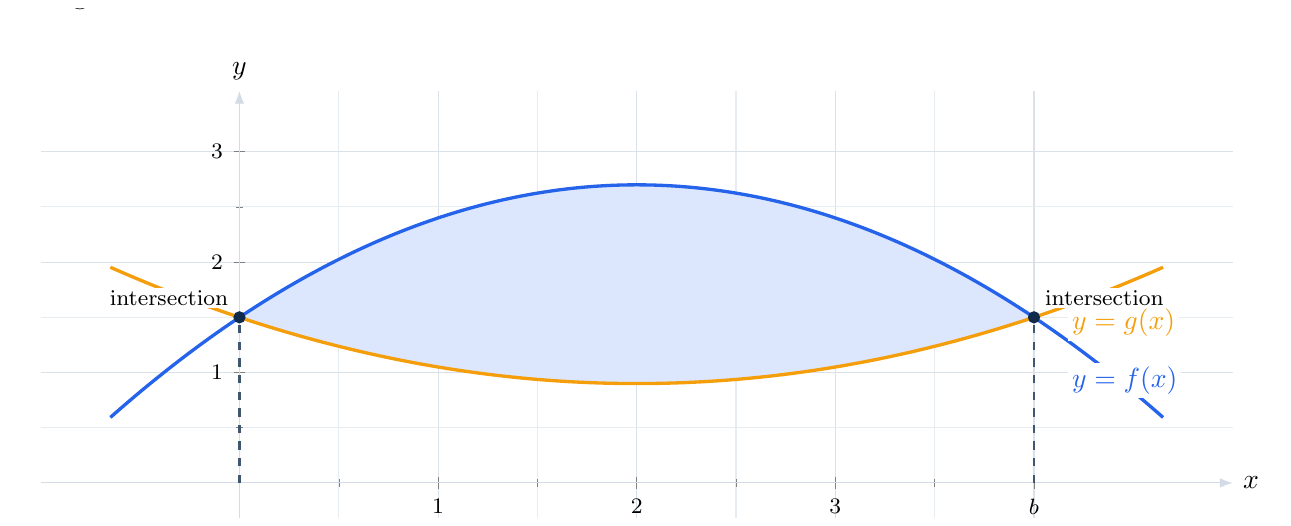
Scenario A: whole enclosed region
Find where the two curves intersect. The \(x\)-coordinates of those intersections usually become the limits of integration.
What you should notice: the shaded region is bounded on the left and right by intersection points.
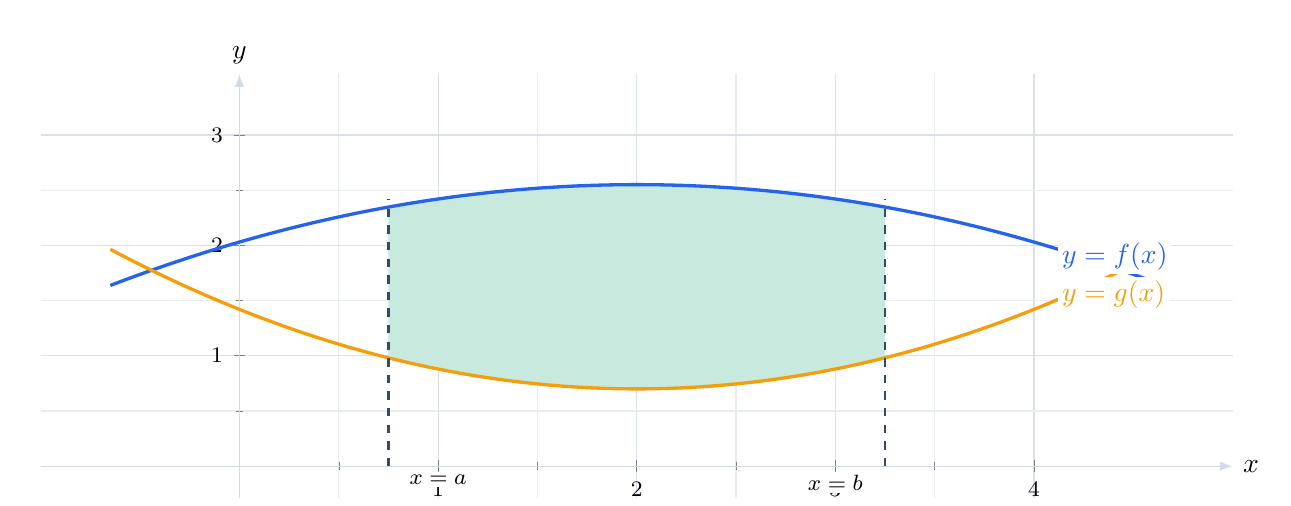
Scenario B: specified interval
Use the boundaries given in the question, such as \(x=a\) and \(x=b\). These do not have to be intersection points.
What you should notice: the shaded region is only the area between the curves on that interval.
Do not automatically solve for intersections if the question already gives the interval. Intersections are needed when they define the enclosed region, or when you need to check whether the upper curve changes inside the interval.
3Step 2: write the formula using upper minus lower
If \(f(x)\) is above \(g(x)\) for every \(x\) in the interval \([a,b]\), then
A safer way to write the same idea is to name the two curves by position, not by letter:
where \(U(x)\) is the upper curve and \(L(x)\) is the lower curve on the interval.
The upper curve is not always the one called \(f\). Always decide which graph is above before writing the integral.
4Step 3: understand why the formula works
The area between two curves can be understood as a subtraction of areas measured from the \(x\)-axis:
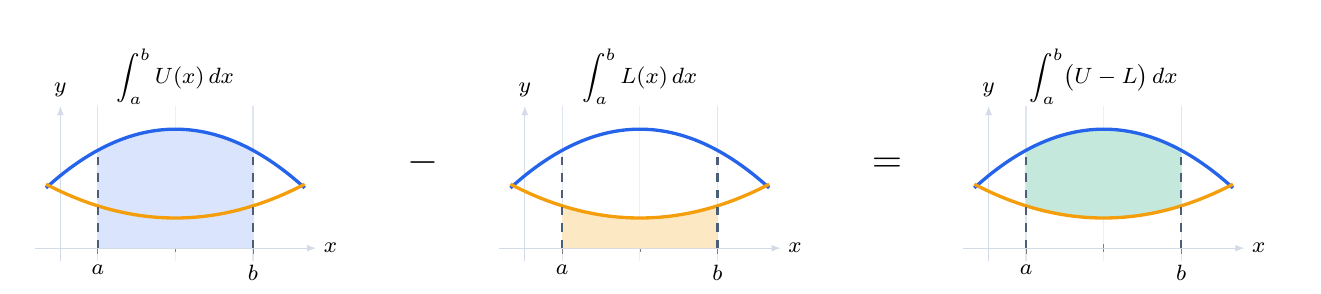
Therefore,
The integral is not measuring two separate areas and hoping for the best. It is accumulating the vertical distance between the upper and lower curve across the interval.
5Step 4: handle changes of upper curve
Another way to write the total area between two curves is
The absolute value makes any negative difference positive. This is especially useful on a calculator or GDC, because the calculator can handle the change of upper curve automatically.
For exact working, the absolute value form usually still needs to be interpreted. If \(f(x)-g(x)\) changes sign, split the interval at the crossing point and use upper minus lower on each part.
6Worked examples
Worked example 1: a parabola and a line
Find the area enclosed by \(y=4-x^2\) and \(y=x+2\).
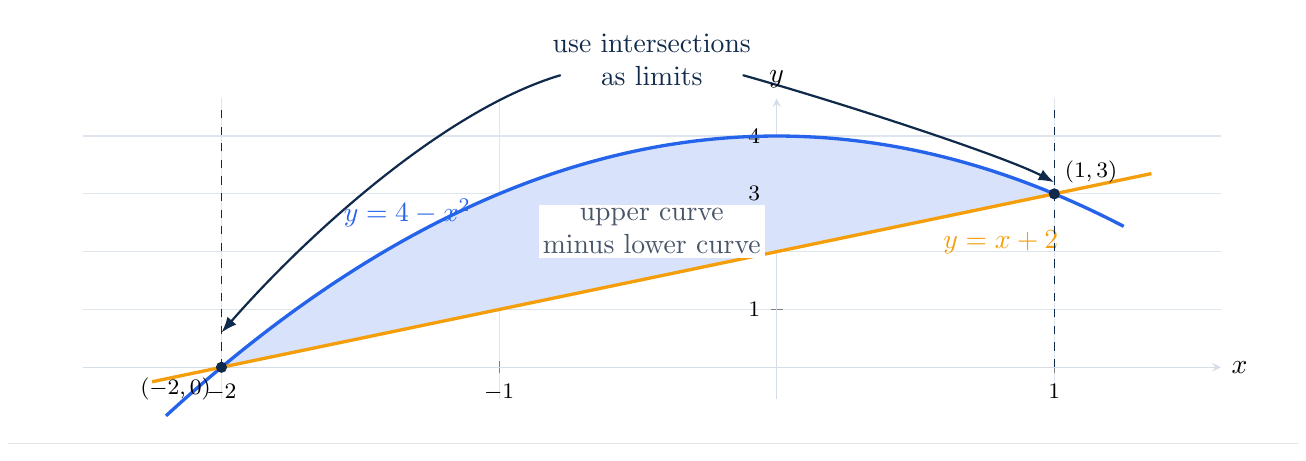
Step 1: find the intersection points.
\[ \begin{aligned} 4-x^2&=x+2\\ -x^2-x+2&=0\\ x^2+x-2&=0\\ (x+2)(x-1)&=0. \end{aligned} \]So \(x=-2\) or \(x=1\). The corresponding intersection points are \((-2,0)\) and \((1,3)\).
Step 2: decide which curve is above. Between \(x=-2\) and \(x=1\), the parabola is above the line.
\[ \begin{aligned} A&=\int_{-2}^1\left((4-x^2)-(x+2)\right)\,dx\\ &=\int_{-2}^1(2-x-x^2)\,dx\\ &=\left[2x-\frac{x^2}{2}-\frac{x^3}{3}\right]_{-2}^1\\ &=\left(2-\frac12-\frac13\right)-\left(-4-2+\frac83\right)\\ &=\frac76+\frac{10}{3}=\frac92. \end{aligned} \]Answer \(\frac92\) square units.
Worked example 2: specified vertical boundaries
Find the area between \(y=4-x^2\) and \(y=x+2\) from \(x=-1\) to \(x=\frac12\).
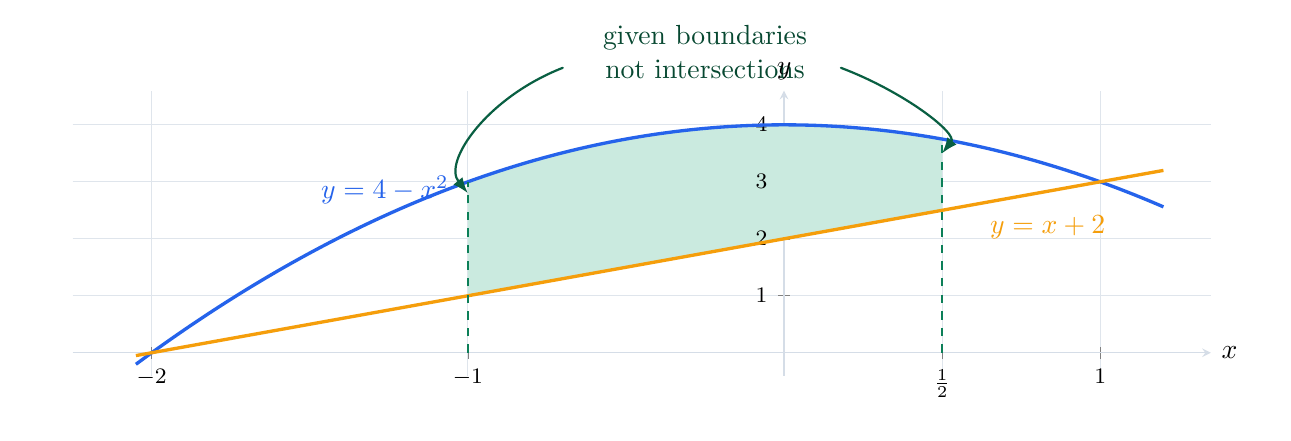
Here the limits are already given. We do not use the full intersection-to-intersection interval. On \(\left[-1,\frac12\right]\), the parabola \(4-x^2\) is above the line \(x+2\), so
\[ \begin{aligned} A&=\int_{-1}^{1/2}\left((4-x^2)-(x+2)\right)\,dx\\ &=\int_{-1}^{1/2}(2-x-x^2)\,dx\\ &=\left[2x-\frac{x^2}{2}-\frac{x^3}{3}\right]_{-1}^{1/2}\\ &=\left(1-\frac18-\frac1{24}\right)-\left(-2-\frac12+\frac13\right)\\ &=\frac56-\left(-\frac{13}{6}\right)=3. \end{aligned} \]Answer \(3\) square units.
Worked example 3: the upper curve changes
Find the area between \(y=x\) and \(y=x^3\) from \(x=-1\) to \(x=1\).
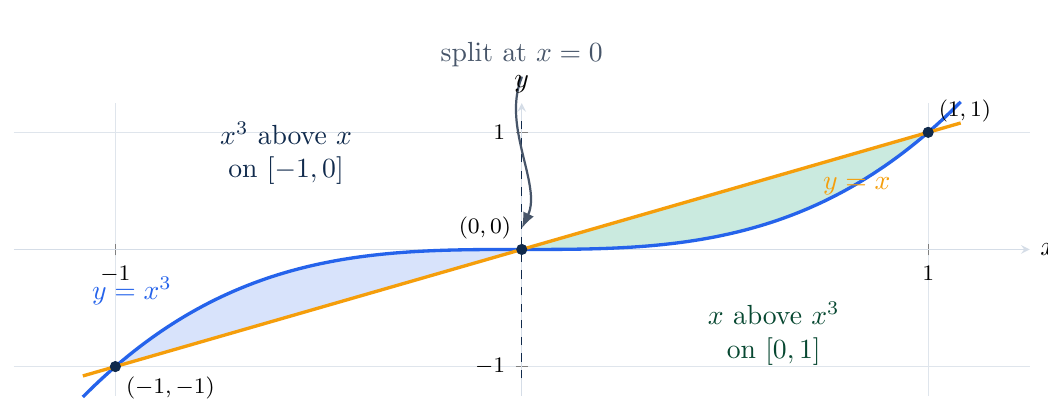
The curves intersect when
\[ x=x^3\quad\Rightarrow\quad x^3-x=0\quad\Rightarrow\quad x(x-1)(x+1)=0. \]So they meet at \(x=-1\), \(x=0\), and \(x=1\). The upper curve changes at \(x=0\): on \([-1,0]\), \(x^3\) is above \(x\); on \([0,1]\), \(x\) is above \(x^3\).
\[ \begin{aligned} A&=\int_{-1}^0(x^3-x)\,dx+\int_0^1(x-x^3)\,dx\\ &=\left[\frac{x^4}{4}-\frac{x^2}{2}\right]_{-1}^0+\left[\frac{x^2}{2}-\frac{x^4}{4}\right]_0^1\\ &=\frac14+\frac14=\frac12. \end{aligned} \]Answer \(\frac12\) square unit.
Equivalently, a calculator could evaluate \(\int_{-1}^1|x-x^3|\,dx\).
7Step-by-step method
- Sketch both curves, or use technology to understand their positions.
- Identify the vertical boundaries. They may be intersection points, or specified values such as \(x=a\) and \(x=b\).
- Find intersections only when needed to define the region or to check whether the upper curve changes.
- Decide which curve is above on each interval.
- Integrate upper minus lower on each interval.
- Use absolute value on a calculator when appropriate: \(A=\int_a^b|f(x)-g(x)|\,dx\).
- Check the answer is positive and matches the shaded region.
8Practice
Try these without looking at the answer key. Draw a quick sketch before setting up each integral.
A. Setup practice
For each question, write the correct integral expression for the area. You do not need to evaluate it.
- The area between \(y=5-x^2\) and \(y=1\) between their intersections.
- The area between \(y=3x\) and \(y=x^2+2\) from \(x=0\) to \(x=1\).
- The area between \(y=x\) and \(y=x^3\) from \(x=-1\) to \(x=1\).
B. Calculate the area
- Find the area between \(y=2x\) and \(y=x^2\) from \(x=0\) to \(x=2\).
- Find the area enclosed by \(y=9\) and \(y=x^2\).
- Find the area enclosed by \(y=6-x^2\) and \(y=x\).
- Find the area between \(y=x\) and \(y=x^3\) from \(x=-1\) to \(x=1\).
- Find the area between \(y=4-x^2\) and \(y=x+2\) from \(x=-1\) to \(x=\frac12\).
C. Conceptual checks
- Explain why \(\int_{-1}^1(x-x^3)\,dx=0\) is not the area between \(y=x\) and \(y=x^3\).
- A student writes \(\int_a^b(f(x)-g(x))\,dx\) because the first function is called \(f\). What extra check must they make before this is correct?
Answer key
A. Setup practice
- Intersections: \(5-x^2=1\Rightarrow x=\pm2\). Since \(5-x^2\) is above \(1\), \[A=\int_{-2}^2\left((5-x^2)-1\right)\,dx.\]
- On \([0,1]\), \(x^2+2\) is above \(3x\), so \[A=\int_0^1\left((x^2+2)-3x\right)\,dx.\]
- Split at \(x=0\): \[A=\int_{-1}^0(x^3-x)\,dx+\int_0^1(x-x^3)\,dx.\]
B. Calculate the area
- \(A=\int_0^2(2x-x^2)\,dx=\left[x^2-\frac{x^3}{3}\right]_0^2=\frac43\).
- Intersections: \(x=\pm3\). \(A=\int_{-3}^3(9-x^2)\,dx=36\).
- Intersections: \(6-x^2=x\Rightarrow x=-3,2\). \[A=\int_{-3}^2\left((6-x^2)-x\right)\,dx=\frac{125}{6}.\]
- \[A=\int_{-1}^0(x^3-x)\,dx+\int_0^1(x-x^3)\,dx=\frac12.\]
- \[A=\int_{-1}^{1/2}(2-x-x^2)\,dx=3.\]
C. Conceptual checks
- The expression \(x-x^3\) changes sign at \(x=0\), so the signed areas cancel. Total area must be found using \(\int_{-1}^1|x-x^3|\,dx\), or by splitting at \(x=0\).
- They must check that \(f(x)\) is above \(g(x)\) for every \(x\) in the interval. If not, they must reverse the order or split the interval.